
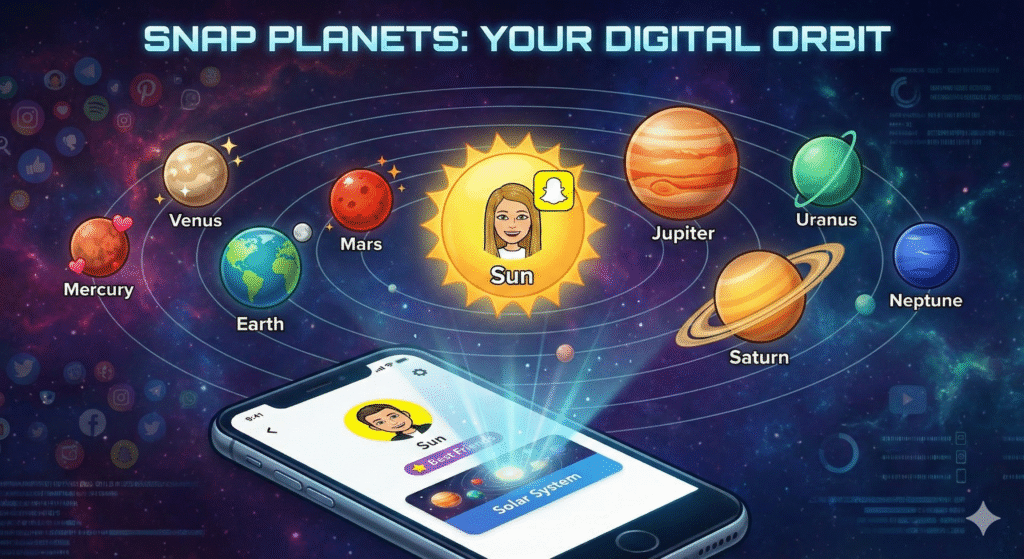
In the hyper-connected ecosystem of modern social media, quantifying friendship has become a digital obsession. We no longer just have friends; we have streaks, scores, and now, celestial bodies defining our relationships. Enter Snap Planets, a feature that has revolutionized how users perceive their social standing within the Snapchat universe. If you have ever wondered exactly where you rank in your best friend’s digital life, this feature provides a visual, albeit sometimes controversial, answer.
Snap Planets, officially known as the “Solar System” feature within Snapchat+, assigns a specific planet to your profile based on your interaction frequency with a friend. It is a hierarchy of intimacy, gamifying social connection in a way that is both fascinating and technically complex. For tech enthusiasts and social media power users, understanding the algorithm behind these planetary assignments is key to navigating the platform’s paid tier. This article serves as your comprehensive manual to the cosmos of Snapchat, breaking down the mechanics, the meanings, and the technology driving this unique social metric. We will explore how these orbits are calculated, what each planet signifies, and how to manage your place in the digital galaxy.
What Are Snap Planets? Defining the Concept
Snap Planets act as a visual representation of your position in another user’s “Best Friends” list. This feature is exclusive to Snapchat+, the platform’s premium subscription service. Unlike the standard “Best Friends” emoji system, which uses hearts and smileys, the Solar System feature offers a granular, ranked view of your friendship.
When you view a friendship profile on Snapchat+, you might see a “Best Friends” or “Friends” badge with a gold ring. Tapping this badge reveals your Snap Planet. If you are the Sun in their solar system, you are the center of their digital universe. However, the system typically assigns you a planet Mercury, Venus, Earth, Mars, Jupiter, Saturn, Uranus, or Neptune corresponding to your rank in their top eight friends. This tech integration turns data analytics into a user-facing, gamified interface.
The Algorithm: How Orbit is Calculated
The technology behind Snap Planets relies on sophisticated frequency algorithms. It is not random; it is purely data-driven. The app analyzes your communication patterns over the last seven to fourteen days to determine your ranking.
Key metrics include:
- Snap Frequency: The sheer volume of photos and videos exchanged.
- Reciprocity: Whether the communication is one-sided or mutual.
- Chat Interaction: Text messages also weigh into the algorithm, though less heavily than Snaps.
The system recalculates these rankings constantly. You might be Mercury (1st closest) in the morning and slip to Venus (2nd closest) by evening if your interaction drops or if another user engages more aggressively. This dynamic updating requires significant backend processing power, showcasing Snapchat’s capability to handle real-time social graph analytics.
The Celestial Hierarchy: From Mercury to Neptune
Understanding the order is crucial for interpreting Snap Planets. The system mimics our actual Solar System, where the friend is the “Sun,” and you are the planet orbiting them. The closer the planet, the higher your rank on their Best Friends list.
The hierarchy is rigid and follows astronomical distance:
- Mercury: 1st Best Friend
- Venus: 2nd Best Friend
- Earth: 3rd Best Friend
- Mars: 4th Best Friend
- Jupiter: 5th Best Friend
- Saturn: 6th Best Friend
- Uranus: 7th Best Friend
- Neptune: 8th Best Friend
If you do not see a planet badge, it means you are not currently in their top eight friends, regardless of how often you message them.
Mercury: The Ultimate Digital Status
In the realm of Snap Planets, Mercury is the crown jewel. Being assigned Mercury means you are the absolute closest friend to that user statistically. You occupy the number one spot on their Best Friends list.
Visually, the Mercury bitmoji representation is distinct. It usually appears as a red planet with hearts floating around it or a similar warm aesthetic. Achieving Mercury status often requires a “Super BFF” level of interaction daily streaks, multiple snaps per day, and consistent chat engagement. For many users, maintaining Mercury status is a competitive endeavor, driving platform engagement metrics significantly higher for Snapchat.
Venus and Earth: The Inner Circle
If you are not Mercury, being Venus or Earth is the next best thing in the Snap Planets ecosystem. Venus represents the 2nd closest friend, while Earth represents the 3rd. These positions indicate a very strong, consistent connection.
- Venus: Represented often with a beige or light-colored planet and hearts. It implies you are essentially a “bestie” but just slightly outpaced by one other person.
- Earth: Instantly recognizable by its blue and green continents and the moon orbiting it. Being Earth means you are a staple in their daily digital life.
Users in these orbits are part of the “Inner Circle.” The algorithm sees these users as primary contacts, ensuring their stories and messages appear first in the feed.
The Outer Rim: Mars, Jupiter, and Saturn
As we move further out in the Snap Planets system, we encounter Mars (4th), Jupiter (5th), and Saturn (6th). While these ranks are lower, being in the top six of anyone’s contact list is significant, especially for users with hundreds of friends.
- Mars: Represented as a red planet with stars. It signifies a solid friendship that might lack the daily intensity of the top three.
- Jupiter: The largest planet, usually shown with orange bands. This often represents a casual but frequent contact.
- Saturn: Distinguished by its rings. Saturn often fluctuates; users here might drop out of the Solar System easily if interaction pauses for a few days.
The Edge of the System: Uranus and Neptune
Occupying the 7th and 8th spots are Uranus and Neptune. In the context of Snap Planets, this is the “danger zone” of the Best Friends list. You are barely holding on to your status as a top friend.
- Uranus: Often depicted as a green planet without hearts or stars.
- Neptune: The furthest blue planet.
Being Neptune means you are one bad day of communication away from disappearing from their solar system entirely. For users who monitor their Snap Planets closely, seeing themselves as Neptune is usually a trigger to initiate a conversation or send a Snap to boost their ranking back toward the inner planets.
Identifying the Bitmoji Graphics
Snapchat does not explicitly label the planets with text when you view them; you must recognize the visual Bitmoji cues. This lack of text adds a layer of exclusivity you have to “know” the code to understand the Snap Planets.
Visual Cheat Sheet:
- Mercury: Red, hearts, extremely close orbit.
- Venus: Yellow/Beige, hearts, sparkles.
- Earth: Blue/Green, Moon present, stars.
- Mars: Red, stars, no hearts.
- Jupiter: Orange striped, stars.
- Saturn: Yellow/Orange with distinct rings.
- Uranus: Green, no hearts.
- Neptune: Dark Blue, cold aesthetic.
Recognizing these graphics instantly allows for quick assessment of friendship status without needing to consult a guide.
Privacy and Visibility: Who Sees What?
A common misconception about Snap Planets concerns privacy. Users often worry that everyone can see their rankings. However, the architecture is designed with privacy in mind.
The Golden Rule: You can only see your own position in someone else’s solar system. You cannot see who their Mercury is if it isn’t you.
- Private View: If you look at a friend’s profile, you see where you stand.
- No Public List: There is no public leaderboard showing a user’s top 8 friends to the world.
This prevents the drama associated with the old “MySpace Top 8” era, keeping the insights personal and between the two users involved.
The Snapchat+ Requirement
It is vital to reiterate that Snap Planets is a paid feature. It is a core selling point of Snapchat+, the subscription tier priced around $3.99/month. Free users cannot see which planet they are in a friend’s system, even if that friend is a subscriber.
The subscription model effectively gates this advanced social analytics data.
- Both users do not need Plus: Only you need the subscription to see your rank.
- Badge Indicator: The “Best Friends” badge with a gold ring is the UI trigger that indicates the feature is active for you on that profile.
Changing Your Orbit: Strategies for Movement
Moving from Neptune to Mercury in the Snap Planets system requires manipulating the algorithm through behavior. Since the system prioritizes recent frequency, a “blitz” strategy often works.
Tactics to Improve Rank:
- Switch to Snaps: Photos and videos carry more weight than text chats.
- Maintain Streaks: A consistent daily streak establishes a baseline of interaction.
- Group Chats Do Not Count: Direct, 1-on-1 interaction is the primary driver for Best Friend status.
- Recency Bias: The algorithm favors the last 7 days. A quiet week will tank your rank, regardless of a 5-year friendship history.
Psychological Impact of Gamified Friendship
The introduction of Snap Planets has sparked debate regarding the gamification of human relationships. Tech psychologists argue that quantifying friendship can lead to anxiety, commonly dubbed “rank anxiety.”
Users may feel slighted if they drop from Mercury to Earth, perceiving a real-world distance that may not exist. Snapchat acknowledged this by adding a feature to turn off the Solar System functionality. If the pressure of Snap Planets becomes too much, users can disable the display in their Snapchat+ settings, hiding their planetary status from themselves to preserve mental peace.
Snap Planets vs. Traditional Friend Emojis
How does this feature compare to the standard emojis we are used to? Snap Planets offers depth where emojis offer breadth.
Table 1: Comparison of Friendship Indicators
| Feature | Standard Friend Emojis | Snap Planets (Solar System) |
| Access | Free for all users | Snapchat+ Subscribers only |
| Visuals | Hearts (💛, ❤️, 💕), Sunglasses (😎) | 3D Rendered Planets |
| Granularity | Broad categories (BF, Bestie, Super BFF) | Exact ranking (1st to 8th) |
| Accuracy | Updates periodically | Updates frequently (near real-time) |
| Scope | Top 1-3 friends mostly | Top 8 friends tracked |
Troubleshooting: Why Can’t I See My Planet?
Sometimes, even subscribers encounter issues where Snap Planets fail to appear. This is usually due to specific algorithmic thresholds not being met.
Common Reasons for Disappearance:
- Not in Top 8: The most common reason is simply that you are not in their top 8 friends.
- Linked Bitmoji: The feature relies heavily on Bitmoji integration; ensure both users have active Bitmojis.
- Feature Disabled: The friend may have deactivated the Solar System feature in their settings to reduce anxiety.
- App Update: An outdated app version often breaks the rendering of new 3D assets like planets.
The Business of Belonging: Is It Worth It?
Is paying for Snap Planets worth the monthly fee? For the casual user, likely not. However, for the younger demographic and power users, social validation is a valuable commodity.
Table 2: Value Proposition of Snap Planets
| Pro | Con |
| Insight: deep dive into friendship dynamics. | Cost: Requires a recurring monthly payment. |
| Validation: Visual confirmation of close bonds. | Anxiety: Potential for hurt feelings over low ranks. |
| Fun: Adds a layer of lore to the app. | Privacy: You cannot see who ranks above you, only your rank. |
The Future of Social Hierarchies in Tech
Snap Planets represents a shift toward paid transparency in social media. We are moving away from the era of “everyone is a friend” to a tiered system where intimacy is calculated and visualized.
Future iterations of this tech could include:
- Historical Data: Seeing how your friendship orbit has changed over months.
- Group Solar Systems: Visualizing the dynamics of a group chat.
- Cross-Platform Metrics: Integration with other social signals.
While the technology is impressive, the user intent remains primal: we all just want to know where we belong. Snap Planets provides a digital answer to that very human question.
Frequently Asked Questions
Can my friend see if I check my Snap Planet rank on their profile?
No, checking your Snap Planets rank is completely anonymous. Snapchat does not notify the other user that you have viewed your friendship profile or checked your planetary status. It is a passive feature designed for your eyes only.
Why did I drop from Mercury to Mars in Snap Planets?
Rankings are dynamic and based on rolling data from the last week or two. If you dropped rank, it likely means your friend interacted significantly more with other people recently, or your own interaction volume with them decreased. It is a relative scale, so other people’s behavior affects your position.
Do text messages count toward Snap Planets rankings?
Yes, text messages sent through the Chat function count toward the algorithm. However, sending Snaps (photos and videos) generally carries a higher “weight” in the calculation. To maintain a high orbit like Mercury, a mix of both Snaps and Chats is recommended.
Can I hide my Solar System status from others?
Yes, Snapchat+ allows you to disable the “Solar System” feature. If you turn this off in your Snapchat+ settings, your friends will not be able to see a planet badge on your profile, even if they have a subscription. This effectively “cloaks” your top 8 list.
What does the “Friend” or “Best Friend” badge mean without a planet?
If you see a badge but tapping it does not reveal a planet, or there is no gold ring, it usually means you are not a Snapchat+ subscriber, or you are outside of that user’s top 8 friends. The planet graphic is exclusive to the top 8 positions.
Is Snap Planets available for free users?
No, Snap Planets (Solar System) is an exclusive feature of Snapchat+. Free users cannot view their planetary rank in a friend’s solar system. However, free users can still be planets in a subscriber’s system; they just won’t be able to see the graphic themselves.
Does the order of Snap Planets ever change?
The astronomical order of the planets (Mercury to Neptune) is fixed and scientifically accurate. What changes is your position within that order. You cannot change the fact that Mercury is #1, but you can change your behavior to become Mercury.
Conclusion
Snap Planets is more than just a quirky add-on for Snapchat+ subscribers; it is a fascinating intersection of data analytics, user interface design, and social psychology. by turning invisible algorithmic data into a visual Solar System, Snapchat has given users a tangible way to measure the strength of their digital relationships.
Whether you are striving to be someone’s Mercury or content floating in the outer rings as Saturn, understanding this feature empowers you to navigate the app with greater awareness. In a world where digital connection is the norm, these planetary badges serve as the modern-day friendship bracelets tech-driven proofs of bond in an infinite feed of content. If you value knowing exactly where you stand, exploring your Snap Planets might just be the insight you need to strengthen your orbit.