
Introduction
In the turbulent ocean of digital marketing, the tides are shifting. The third-party cookie is crumbling, privacy regulations like GDPR and CCPA are tightening their grip, and the “surveillance economy” is facing a reckoning. Marketers who have relied for decades on persistent user tracking are suddenly navigating in the dark. Into this void steps a revolutionary framework: TransDS, or Transient Data Synchronization.
TransDS represents a paradigm shift from “who the user is” to “what the user is doing right now.” It is the science of capturing, analyzing, and acting upon ephemeral, session-based data signals without relying on invasive, long-term storage of personal identities. For the modern Chief Marketing Officer (CMO) or digital strategist, understanding TransDS is no longer optional it is the survival kit for the privacy-first era. This article will dismantle the mechanics of TransDS, exploring how this methodology not only solves the compliance puzzle but actually increases conversion rates by focusing on immediate intent rather than historical assumptions. Prepare to future-proof your marketing stack.
What is TransDS? Decoding the Acronym
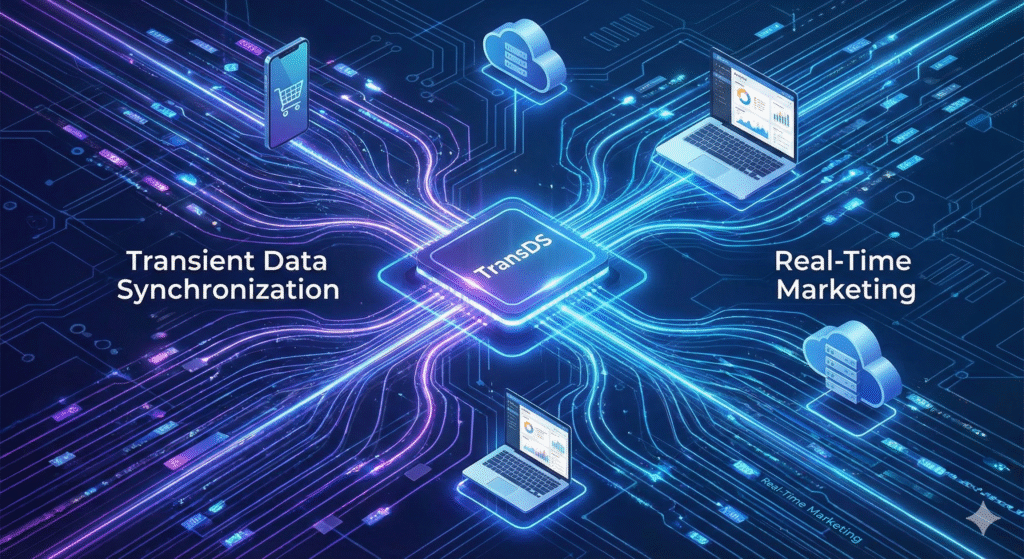
At its core, TransDS stands for Transient Data Synchronization. It is a data processing methodology designed to synchronize immediate, short-lived user signals (transient data) with marketing automation systems in real-time. Unlike traditional CRM approaches that build a “permanent record” of a user, TransDS focuses on the “micro-session.”
- Transient Nature: Data exists only for the duration of the session.
- Synchronization: Data is instantly mapped to intent models to trigger personalization.
- Privacy-First: Once the session ends, personal identifiers are anonymized or discarded.
The Death of Cookies and the Rise of TransDS
The reliance on third-party cookies created a lazy marketing ecosystem. We assumed we knew what users wanted because we knew where they had been last week. TransDS challenges this by asserting that current context is a better predictor of conversion than past history.
With browsers like Safari and Chrome limiting cookie lifespans, TransDS offers a robust alternative. It utilizes server-side tagging and first-party session data to understand user behavior, ensuring that marketing efforts remain effective even in a “cookieless” environment.
Core Components of the TransDS Framework
A successful TransDS strategy is built on three pillars: Capture, Compute, and Connect.
- Capture: Utilizing edge computing to gather signals like mouse velocity, scroll depth, and active time on page.
- Compute: Using lightweight AI models to score “intent” in milliseconds.
- Connect: Triggering the CMS to alter the page layout or offer a discount instantly.
TransDS vs. Persistent Identity Tracking
To understand the value proposition, we must contrast TransDS with the legacy methods of identity resolution.
Table 1: The TransDS Difference
Optimizing Conversion Rates (CRO) with TransDS
Conversion Rate Optimization has traditionally been reactive analyzing data after the user leaves. TransDS makes CRO proactive. By analyzing transient signals, the system can detect hesitation.
If a user rapidly toggles between two product tabs (a distinct TransDS signal), the system recognizes “comparison anxiety” and can instantly trigger a comparison chart popup. This real-time responsiveness significantly boosts conversion probability.
The Role of AI in TransDS
Artificial Intelligence is the engine that makes TransDS viable. Human analysts cannot process live streams of millions of transient signals. Machine learning models, specifically “TinyML” (Tiny Machine Learning), are deployed to process data locally on the user’s device or at the network edge.
- Predictive Scoring: AI predicts the likelihood of purchase within the next 60 seconds.
- Dynamic Pricing: Adjusting bundle offers based on current engagement intensity.
Implementing TransDS in Your Tech Stack
Adopting TransDS requires a shift in infrastructure. You cannot rely solely on standard Google Analytics, which aggregates data with a delay.
- Server-Side Tagging: Move tracking from the browser to the server to control data flow.
- Customer Data Platform (CDP): Ensure your CDP can handle streaming data, not just batch uploads.
- Edge Functions: Use tools like Cloudflare Workers or AWS Lambda to process TransDS signals closer to the user.
Privacy Compliance: GDPR and CCPA
The strongest selling point of TransDS is its inherent compliance. Because the data is “transient” meaning it is not stored permanently it often falls outside the stringent requirements of “data processing” that require heavy consent forms.
- Data Minimization: TransDS embodies the GDPR principle of collecting only what is necessary.
- Right to be Forgotten: Since data is deleted post-session, this compliance request is automatically met.
TransDS for E-Commerce Personalization
E-commerce is the “killer app” for TransDS. Imagine a user visiting a fashion site. They don’t log in. They look at red raincoats.
A legacy system sees an “Unknown User.” A TransDS system sees “User interested in Red/Outerwear/High-Intent.” It immediately reorganizes the homepage to show matching boots and umbrellas. This “zero-party” personalization feels magical to the user rather than creepy.
Challenges in Adopting TransDS
Transitioning to TransDS is not without hurdles.
- Technical Debt: Legacy systems are built for static records, not streams.
- Skill Gap: Marketing teams need to understand data streams, not just demographics.
- Attribution: Multi-touch attribution becomes harder when you stop tracking users across long timeframes.
TransDS Analytics: Measuring Success
How do you measure success if you don’t track the user for months? TransDS introduces new metrics:
- Session Velocity: How fast a user moves from landing to checkout.
- Signal Density: The number of interactions per minute.
- Instant Conversion Rate (ICR): Conversions that happen in the same session as the first touch.
Case Study: Travel Industry Success
A leading European travel agency implemented TransDS to combat high abandonment rates. By analyzing cursor movements and search patterns (transient signals), they identified users who were “price sensitive” versus those who were “urgency driven.”
Result:
- Users identified as “Urgency Driven” were shown “Only 2 seats left” badges.
- Users identified as “Price Sensitive” were shown “Bundle and Save” offers.
- Outcome: A 14% increase in booking completion using TransDS logic.
Tools and Platforms Supporting TransDS
While TransDS is a methodology, several tools facilitate it.
- Segment (Twilio): For real-time data piping.
- Snowplow Analytics: For granular behavioral data collection.
- Tealium: For server-side data control and synchronization.
Future-Proofing with TransDS
The digital landscape will only become more fragmented. The Metaverse, IoT, and voice search are all channels that generate massive amounts of transient data but struggle with persistent cookies. TransDS is platform-agnostic. Whether the signal comes from a VR headset or a smart fridge, TransDS processes the intent and synchronizes the response.
Developing a TransDS-First Culture
To succeed, organizations must stop asking “Who is this customer?” and start asking “What does this customer need right now?” This cultural shift moves marketing from identity-obsessed to utility-obsessed. TransDS empowers teams to be helpful in the moment, which is the ultimate builder of brand trust.
Final Verdict: The TransDS Advantage
In the end, TransDS is about respecting the user. It is a tacit agreement: “I will not stalk you across the internet, but I will pay extreme attention to you while you are here.” This trade-off privacy for relevance is the winning formula for the next decade of digital marketing.
Frequently Asked Questions
How does TransDS differ from standard real-time analytics?
Standard real-time analytics often just “report” what is happening (e.g., “50 users on site”). TransDS goes a step further by “synchronizing” that data with action systems to change the user experience immediately based on those analytics.
Does TransDS require us to delete all customer data?
No. TransDS is primarily for anonymous or unauthenticated sessions. Once a user logs in and consents, you can merge TransDS insights into your permanent CRM. It bridges the gap between the unknown and the known.
Is TransDS expensive to implement?
It can be cost-effective in the long run. While setting up the infrastructure (edge computing, CDPs) has an upfront cost, TransDS reduces the massive storage costs associated with hoarding terabytes of stale third-party data.
Will TransDS work for B2B marketing?
Yes. B2B buying cycles are long, but individual research sessions are intense. TransDS helps B2B marketers identify high-intent research behavior (e.g., visiting the pricing page three times in one session) and trigger a chat bot immediately.
Can TransDS replace Google Analytics?
Not entirely. Google Analytics is great for aggregate trend analysis. TransDS is designed for individual session optimization. They work best in tandem: TransDS for the “now,” GA for the “history.”
Is TransDS reliant on third-party cookies?
No. TransDS is fundamentally designed to operate without third-party cookies. It relies on first-party data, local storage, and server-side signals, making it immune to browser privacy blocks like ITP.
Do I need a data scientist to run TransDS campaigns?
While having a data scientist helps setup the models, many modern marketing platforms are building TransDS logic into their user interfaces, allowing marketers to set rules like “If scroll speed is fast, show X” without coding.
Conclusion
The digital marketing playbook is being rewritten, and TransDS is the pen. As we bid farewell to the era of unrestricted surveillance and cookie-based dependency, we welcome a cleaner, faster, and more effective way of connecting with audiences. TransDS offers a path where privacy and personalization coexist.
By focusing on the transient, the immediate, and the actionable, brands can unlock a level of agility that legacy systems simply cannot match. The shift to TransDS is not just a technical upgrade; it is a strategic imperative. For the digital marketer aiming to rank on Google’s first page of relevance in the customer’s mind, mastering TransDS is the only way forward. Start synchronizing your signals today, and watch your engagement transform.