
Introduction
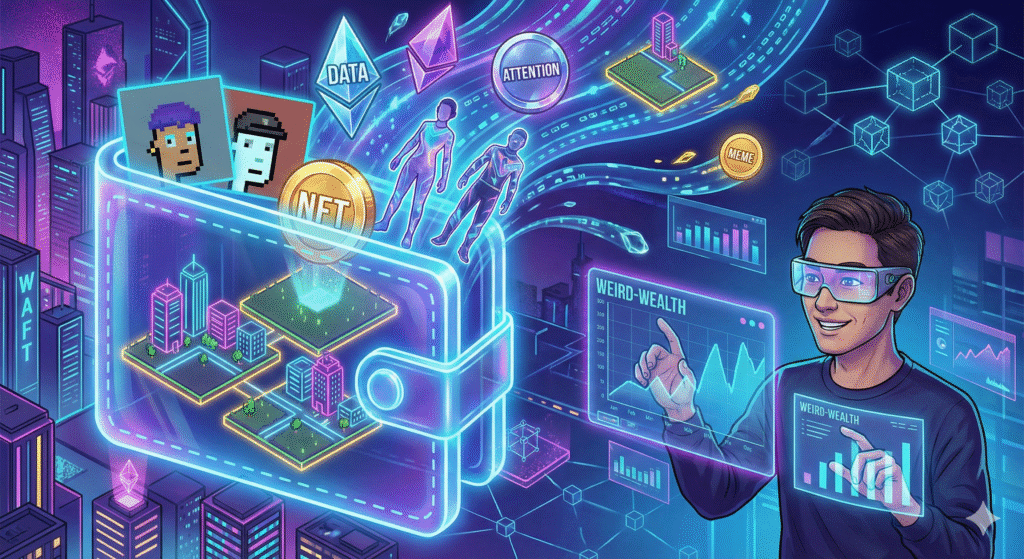
In the not-so-distant past, wealth was synonymous with tangible assets: stocks, real estate, gold, and corporate equity. Today, however, the digital revolution has birthed a new, perplexing, and highly lucrative phenomenon known as weird-wealth. This concept refers to the generation of massive financial value from assets that seem intangible, bizarre, or completely nonsensical to the traditional investor. From pixelated images of punks selling for millions to virtual plots of land in the Metaverse that exist only on servers, technology has rewritten the rules of capitalization.
The significance of weird-wealth in today’s world cannot be overstated. It represents a democratization of finance where coding skills, gaming proficiency, or meme literacy can outperform a Wall Street portfolio. As we move deeper into the Web3 era, understanding these unconventional revenue streams is no longer just for internet subcultures; it is essential for anyone looking to diversify in the information economy. This article serves as your comprehensive guide to navigating these strange digital waters. We will dissect the mechanisms behind these tech-driven economies, provide actionable insights on how they function, and explore whether this financial shift is a sustainable future or a fleeting bubble. Prepare to expand your definition of value.
Defining Weird-Wealth in the Tech Sector
The term weird-wealth in the technology sector encompasses asset classes that derive value from scarcity, community consensus, and utility within digital ecosystems rather than physical properties or traditional cash flows. It is the monetization of the abstract.
This new economy thrives on the internet’s ability to create niche markets instantly. What might seem like a “weird” asset to a baby boomer such as a rare skin for a video game weapon holds genuine, liquid value to a Gen Z gamer.
- Intangibility: Most assets exist solely as code on a blockchain or server.
- Community-Driven Value: Prices are often dictated by social sentiment rather than P/E ratios.
- High Volatility: These markets can experience massive swings based on trends and technological updates.
The Rise of Virtual Real Estate
One of the most prominent pillars of weird-wealth is the booming market for virtual land. Platforms like Decentraland and The Sandbox allow users to purchase digital plots where they can build experiences, host events, or advertise.
Investors are treating these pixels with the same seriousness as Manhattan real estate. The logic is simple: if people spend their time in digital spaces, the location within those spaces becomes valuable inventory for commerce and attention.
- Location Matters: Plots near “spawn points” or celebrity estates command higher prices.
- Commercial Utility: Brands buy land to open virtual storefronts.
- Passive Income: Owners can rent out their land to developers or event organizers.
NFTs: Beyond the Hype Cycle
Non-Fungible Tokens (NFTs) became the poster child for weird-wealth when digital art collections began selling for eight figures. While the initial frenzy has cooled, the underlying technology remains a powerhouse for proving digital ownership.
NFTs turn infinite digital reproducibility into verifiable scarcity. This technology extends far beyond JPEGs of monkeys; it is now being used for digital identity, ticketing, and intellectual property rights.
- Provenance: Blockchain history proves authenticity and ownership.
- Royalties: Creators earn a percentage of secondary sales automatically.
- Utility: Some NFTs grant access to private communities or software tools.
Play-to-Earn Gaming Economies
For decades, gamers poured money into games with no return. The Play-to-Earn (P2E) model flips this, allowing players to generate weird-wealth by grinding for in-game assets that can be sold for cryptocurrency.
In countries like the Philippines, P2E games like Axie Infinity momentarily provided incomes higher than the national minimum wage. This blurred the line between leisure and labor, creating a new class of digital worker.
- Tokenomics: Players earn native tokens for winning battles or completing quests.
- Asset Ownership: Players own their in-game items and can sell them on open markets.
- Scholarships: Wealthy players lend assets to new players for a cut of the earnings.
The Modern Domain Name Gold Rush
In the 90s, buying generic .com domains was a path to riches. Today, a similar form of weird-wealth is emerging with Web3 domains (like .eth or .sol) and handshake domains.
These aren’t just website addresses; they are your payment gateway and digital identity rolled into one. Short, recognizable names are trading for thousands of dollars as users rush to secure their handle for the decentralized web.
- Identity Simplification: Replaces complex wallet addresses with human-readable names.
- No Renewal Fees: Some handshake domains offer one-time purchase models.
- Speculation: Investors hoard generic names hoping for future brand buyouts.
Bug Bounties: Ethical Hacking Riches
White-hat hackers are generating significant weird-wealth by hunting for vulnerabilities in corporate software. Major tech companies pay massive premiums to individuals who can find exploits before malicious actors do.
This gig economy for cybersecurity professionals has turned bug hunting into a viable full-time career. It transforms distinct technical knowledge into immediate, high-value payouts without a traditional employment contract.
- Platform Access: Sites like HackerOne connect companies with hackers.
- Varied Payouts: Rewards range from $500 to over $1,000,000 for critical flaws.
- Skill-Based: Pure meritocracy where credentials matter less than results.
Data Dividends: Selling Your Digital Footprint
We generate valuable data every second, usually giving it away for free to tech giants. New platforms are emerging that allow users to reclaim this value, creating a stream of weird-wealth from their own browsing habits.
These “data unions” or browser extensions aggregate user data and sell it ethically, sharing the profits back with the user. It shifts the power dynamic of the surveillance economy.
- Passive Income: Earn crypto or cash just by browsing the web.
- Privacy Control: Users choose what data to share and anonymize.
- Market Research: Companies pay premiums for high-quality, consensual consumer data.
Creator Coins and Social Tokens
Imagine if you could have bought stock in a YouTuber before they became famous. Social tokens allow creators to launch their own economies, where fans buy coins to access exclusive content or vote on channel decisions.
This form of weird-wealth aligns the incentives of the creator and the audience. If the creator succeeds, the token value rises, rewarding the early supporters who held the currency.
- Gated Access: Tokens act as keys to private Discord servers or content.
- Loyalty Rewards: Creators distribute tokens to their most active fans.
- Financial Bonding: The audience becomes invested in the creator’s success.
AI Model Training Markets
The explosion of Artificial Intelligence has created a demand for niche, high-quality datasets. Individuals are finding ways to generate weird-wealth by curating and selling specialized data to train AI models.
From recording voice samples to tagging images, the human labor required to feed the algorithms is becoming a micro-economy. Even selling unique personal writing styles or art styles for LoRA training models is emerging.
- Micro-Tasking: Platforms pay for labeling and sorting data.
- Niche Expertise: Medical or legal professionals selling anonymized expert data.
- Passive Licensing: Licensing personal voice or likeness for AI generation.
Airdrop Farming Strategies
In the crypto world, protocols often distribute free tokens to early users to decentralize governance. “Farming” these airdrops has become a sophisticated method of accumulating weird-wealth.
Users interact with testnets, bridge assets, and provide liquidity across various platforms in hopes of qualifying for a future payout. Some airdrops have netted individual users five to six figures instantly.
- Retroactive Rewards: Payments for past usage of a product.
- Sybil Attacks: Users creating multiple wallets to game the system (highly risky).
- Engagement: Requires active participation in new tech ecosystems.
The Economy of Memecoins
Perhaps the most controversial form of weird-wealth is the memecoin market. Tokens based on internet jokes (like Dogecoin or Pepe) can reach multi-billion dollar market caps purely on social sentiment.
While often dismissed as gambling, successful memecoin trading requires a deep understanding of internet culture, virality mechanics, and community psychology. It is the monetization of attention and humor.
- Viral Marketing: Success depends on community raiding and social media presence.
- High Risk: Most memecoins go to zero; the winners generate massive returns.
- Community Cults: Strong communities hold the floor price during downturns.
Digital Fashion and Skins
Gamers and Metaverse inhabitants care deeply about how their avatars look. Digital fashion clothing that can only be worn virtually is a booming industry generating weird-wealth for designers.
Luxury brands like Gucci and Balenciaga are entering the space, selling limited edition virtual items. For independent 3D artists, this opens a global market with zero physical material costs.
- Status Symbol: Rare skins signal veteran status or wealth in-game.
- Interoperability: The push for assets that work across different games.
- Low Overhead: No shipping, manufacturing, or fabric costs.
DeSci: Decentralized Science Funding
Decentralized Science (DeSci) is using blockchain to fund research that traditional institutions ignore. Investors can fund longevity research or space exploration and own a stake in the resulting IP, creating scientific weird-wealth.
This model allows ordinary people to invest in high-risk, high-reward scientific breakthroughs, bypassing the bureaucratic grant system of academia.
- IP-NFTs: Intellectual property rights represented as tokens.
- DAO Governance: Donors vote on which research projects to fund.
- Data Marketplaces: Researchers sell raw data directly to other scientists.
Fractionalized Ownership of Assets
Technology now allows expensive assets to be split into millions of shares. You no longer need to be a millionaire to own a Picasso or a vintage Ferrari; you can own a $50 fraction of it.
This democratizes access to high-end investments, allowing weird-wealth portfolios to include slivers of blue-chip art, collectibles, and luxury goods.
- Liquidity: Easier to sell a fraction of a painting than the whole thing.
- Diversification: Owning 1% of 100 assets rather than 100% of one.
- Accessibility: Entry points as low as $10 or $20.
The Attention Economy Metrics
In the information age, attention is currency. Platforms that measure and monetize attention directly like Brave Browser granting tokens for viewing ads are formalizing this exchange.
Users are learning to value their time and attention span as an asset class. Weird-wealth is generated by strategically directing this attention to platforms that pay for it.
- Watch-to-Earn: Getting paid to consume content.
- Referral Economies: Monetizing social networks by onboarding others.
- Influence Metrics: High engagement scores translating to direct payments.
Automated Trading Bots
Coding savvy individuals are building automated bots to arbitrage price differences across digital exchanges. This generates weird-wealth while the creator sleeps, capitalizing on market inefficiencies.
These “MEV” (Maximal Extractable Value) bots scan blockchains for pending transactions and front-run them, or balance prices between decentralized exchanges.
- Flash Loans: Borrowing millions for seconds to execute arbitrage without capital.
- High Technical Barrier: Requires advanced coding and blockchain knowledge.
- Passive Income: Once deployed, successful bots run autonomously.
The Risks of Unconventional Tech Assets
The pursuit of weird-wealth is fraught with danger. The lack of regulation and the experimental nature of these technologies mean that total loss is a common occurrence.
Scams, rug pulls (where developers abandon a project), and smart contract hacks are prevalent. Understanding the risk profile is as important as understanding the upside.
- Smart Contract Risk: Code bugs can lead to drained funds.
- Regulatory Uncertainty: Governments may ban or heavily tax these assets.
- Liquidity Traps: Being unable to sell an asset when the market crashes.
Future Trends in Digital Value
The trajectory of weird-wealth suggests a future where everything can be tokenized. We are moving toward a “hyper-financialized” world where reputation, time, and even computing power are tradable commodities.
As AI agents begin to transact with each other, we may see economies formed entirely by machines, generating wealth in ways humans can barely comprehend.
- Personal IPOs: Individuals selling equity in their future earnings.
- AI Economies: Bots hiring other bots for micro-services.
- Universal Digital Income: Value generated by personal data supporting livelihoods.
Traditional Wealth vs. Weird-Wealth Comparison
| Feature | Traditional Wealth | Weird-Wealth |
| Primary Assets | Stocks, Bonds, Real Estate, Gold | NFTs, Crypto, Skins, Data, Virtual Land |
| Source of Value | Cash flow, earnings, physical utility | Scarcity, community, network effects, memes |
| Liquidity | Market hours, banking delays | 24/7 global markets, instant settlement |
| Barrier to Entry | Capital, credit checks, brokers | Internet connection, digital wallet, knowledge |
| Risk Profile | Moderate, regulated, insured | Extreme, unregulated, “wild west” |
| Custodian | Banks, brokerages | Self-custody (Private keys) |
Case Study – The Million Dollar Pixel
To illustrate the extreme potential of weird-wealth, we look at the historical example of “The Million Dollar Homepage” and its modern successors.
| Project | Concept | Outcome | Weird-Wealth Factor |
| Million Dollar Homepage (2005) | Selling 1M pixels for $1 each on a static webpage. | Sold out in 4 months. Creator Alex Tew made $1M. | Monetized pure novelty and internet history. |
| Decentraland “Fashion Street” (2021) | A virtual plot of land sold to Tokens.com. | Sold for $2.4 million USD. | Digital land valued higher than physical US homes. |
| CryptoPunks (2017-Present) | Free pixel art characters claimed by early users. | Single punks have sold for over $23 million. | Free digital images became blue-chip status symbols. |
Frequently Asked Questions
What exactly is weird-wealth in the context of technology?
Weird-wealth refers to financial value generated from non-traditional, often intangible digital assets or activities. This includes cryptocurrencies, NFTs, virtual real estate, in-game items, and monetizing data or attention. It is “weird” because it challenges conventional understandings of what constitutes an asset.
Is investing in virtual real estate actually profitable?
It can be, but it is highly speculative. Early investors in platforms like Decentraland or The Sandbox saw massive returns (sometimes 100x). However, prices have fluctuated wildly. Profitability depends on location, platform adoption, and the ability to develop the land for commercial use.
How do I start generating weird-wealth with little money?
You can start with “sweat equity” rather than capital. This includes farming airdrops by testing new protocols, participating in play-to-earn games, hunting for bugs if you have coding skills, or creating content to earn social tokens. These require time and skill rather than upfront cash.
Are these digital assets taxed by the government?
Yes, in most jurisdictions, weird-wealth is taxable. Crypto gains, NFT sales, and income from mining or staking are typically treated as capital gains or income. It is crucial to use tracking software and consult a tax professional familiar with digital assets.
What is the biggest risk associated with weird-wealth assets?
The biggest risk is volatility and security. Assets can lose 90% of their value overnight due to market shifts. Additionally, because you are often your own bank (self-custody), if you lose your passwords (seed phrases) or get hacked, there is no customer support to recover your funds.
Can AI really help me generate weird-wealth?
Yes. You can use AI to code trading bots, generate art for NFTs, or create content at scale. Furthermore, new markets are emerging where you can sell data to train AI models or rent out your computer’s GPU power to AI companies for crypto payments.
Is weird-wealth a bubble that will eventually burst?
Parts of it are certainly bubbles (like specific memecoins or low-quality NFT projects). However, the underlying trend of the digitalization of value is likely permanent. As we spend more time online, the economy will naturally follow, cementing the legitimacy of digital assets.
Conclusion
The concept of weird-wealth is a testament to the transformative power of technology. It has shattered the glass ceiling of traditional finance, allowing value to emerge from the strangest corners of the internet from memes and video games to code vulnerabilities and virtual dirt. While it is easy to dismiss these trends as fleeting fads, the data suggests a fundamental shift in how human beings perceive and store value.
Navigating this landscape requires a blend of technical literacy, open-mindedness, and cautious risk management. You do not need to liquidate your 401(k) to buy virtual land, but ignoring this sector entirely is a risk in itself. Whether you are a developer, a creator, or an investor, the opportunities to unlock weird-wealth are vast and accessible. As the digital and physical worlds continue to merge, the “weird” economies of today will likely become the standard portfolios of tomorrow. Take the time to educate yourself, experiment with small amounts, and remain curious because in the information age, the strangest ideas often have the highest returns.