
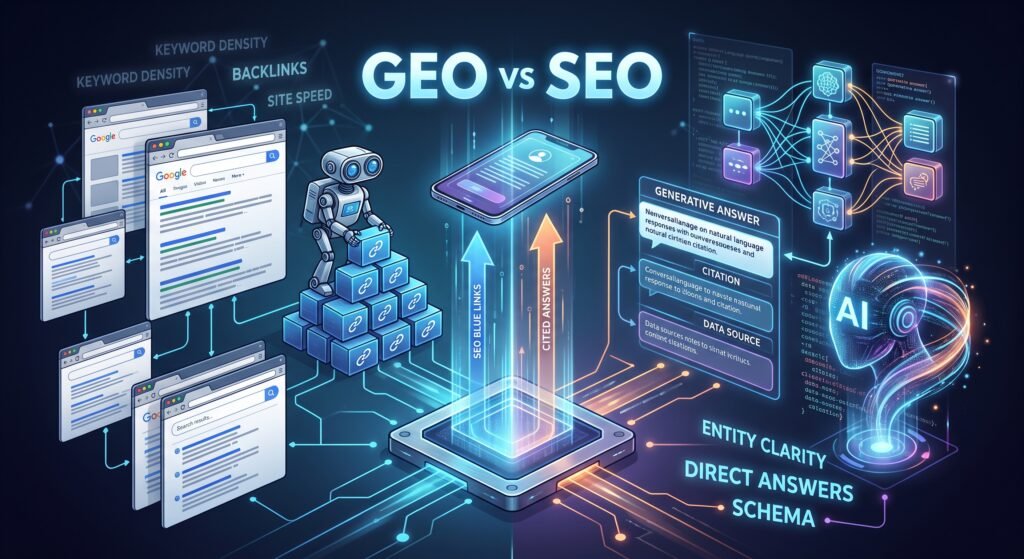
The digital search landscape is undergoing a massive transformation. For decades, businesses relied solely on traditional Search Engine Optimization (SEO) to secure top rankings on blue links across search engine results pages. Today, the rise of Large Language Models (LLMs), AI Overviews, Perplexity, and ChatGPT has birthed a revolutionary discipline: Generative Engine Optimization (GEO).
Understanding geo vs seo is no longer optional for digital marketers, content creators, and business leaders it is the single most critical factor for future web visibility.While SEO focuses on driving direct clicks by ranking web pages on traditional search engines, GEO aims to position your content as the authoritative primary source that AI models cite, summarize, and reference directly within generated answers.
This comprehensive, future-focused guide will explore the core differences, technical mechanics, content strategies, and dual-optimization frameworks of geo vs seo. By blending these two powerful approaches, you will protect your online presence, adapt to AI-driven discovery, and capture highly qualified organic audience traffic for years to come.
Understanding the Core Mechanics: How GEO and SEO Function Differently
Traditional search relies on index crawling and keyword matching, whereas generative search synthesizes information using multi-modal AI models and complex semantic reasoning.To build an effective strategy, you must first understand the underlying technological mechanisms separating geo vs seo.
- Algorithmic Retrieval vs. Dynamic Synthesis:SEO leverages web crawlers to index pages and rank them based on technical health, keyword relevance, and backlink authority.GEO uses advanced vector embeddings, Retrieval-Augmented Generation (RAG), and neural networks to summarize trusted insights on demand.
- Click-Through Intent vs. Zero-Click Answers:Traditional SEO targets user clicks to destination URLs.GEO focuses on “zero-click” conversational resolution, where being included in the primary AI citation yields long-term authority and higher brand recall.
- Exact Keyword Strings vs. Semantic Entities:Classical SEO tracks specific search volume metrics and keyword densities.In contrast, GEO evaluates entity relationships, topical depth, clear definitions, and factual citations.
- Destination URLs vs. Contextual References:Traditional search delivers ten blue links on a results page.Generative search returns a cohesive response that weaves multiple web sources together, making conversational inclusion the ultimate digital asset.
Key Ranking Drivers: What Search Engines vs AI Assistants Prioritize
To rank on Google and secure AI citations, content creators must align with the specific signal metrics favored by algorithms and language models.The evaluation parameters for geo vs seo showcase distinct priorities across both ecosystems.
               KEY OPTIMIZATION PRIORITIES
    ┌───────────────────────┬───────────────────────┐
    │     TRADITIONAL SEO   │     GENERATIVE GEO    │
    ├───────────────────────┼───────────────────────┤
    │  Technical Site Speed │  Verifiable Statistics│
    │  Backlink Profile     │  Entity Clarity & RAG │
    │  On-Page Metadata     │  Direct Quotations    │
    │  Keyword Placement    │  Conversational Depth │
    └───────────────────────┴───────────────────────┘
- Data and Statistics Integration:Studies reveal that content containing verified data, numerical metrics, and direct quotes experiences a 30% to 40% higher probability of being cited by AI engines compared to generic text.
- Entity Establishment:Generative platforms prioritize clearly defined entities people, products, frameworks, and brands that maintain consistent schema markup across the web.
- Technical Health Foundations:SEO heavily values clean site architecture, server-side rendering, quick load times, and mobile responsiveness.AI crawlers also struggle with client-side JavaScript, making server-side rendering crucial for GEO visibility.
- E-E-A-T Signal Authority:Google’s Experience, Expertise, Authoritativeness, and Trustworthiness (E-E-A-T) framework serves as a critical bridge connecting both search strategies.AI engines heavily favor content created by verified industry experts.
Comparing GEO vs SEO Strategies
| Optimization Metric | Traditional SEO | Generative Engine Optimization (GEO) |
| Primary Goal | Top 10 rankings on Search Engine Results Pages (SERPs) | Inclusion, citation, and brand mentions in AI outputs |
| Primary Target | Web crawlers (Googlebot, Bingbot) | Large Language Models (GPT-4o, Gemini, Claude, Perplexity) |
| User Interaction | User clicks link $\rightarrow$ visits website | User receives conversational answer $\rightarrow$ checks cited sources |
| Content Formatting | Structured headers, meta tags, and keyword placement | Clear Q&A pairs, statistics, expert quotes, and bullet points |
| Core Technical Metric | Core Web Vitals, crawl budget, and indexability | Server-side rendering, JSON-LD schema, and readable HTML |
| Link Building Focus | High Domain Authority (DA) dofollow backlinks | Brand mentions, unlinked press citations, Reddit, and Wikipedia |
Content Structuring for GEO and SEO Success
Structuring your content correctly ensures that both search crawlers and AI answer engines can digest, process, and display your information effortlessly.Blending formatting techniques builds a future-proof publishing pipeline.
- Lead with Direct Answers (BLUF Method): Apply the “Bottom Line Up Front” approach. Begin every section with a concise 1-2 sentence definition or answer before diving into complex details.
- Incorporate Semantic Question Headers:Craft section headings that mirror standard natural language questions asked by target audiences in conversational queries.
- Utilize Clear Data Tables:Convert complex comparative variables into clean Markdown tables.AI language models favor tabular formats for extracting quick facts during dynamic answer assembly.
- Implement Schema Markup:Utilize
FAQPage,Article,Organization, andHowTostructured JSON-LD data to provide explicit machine-readable context.
The Role of E-E-A-T and Information Gain in Modern Search
Search engines and generative models are systematically de-valuing generic, repetitive AI-generated text. Modern algorithms prioritize real human experience, unique insights, and original research.
- Prioritize Information Gain: Information gain measures the new, unique value an article provides beyond existing indexed web content. Publishing original surveys, proprietary data, or unique case studies boosts both GEO citations and organic SEO rankings.
- Display Transparent Expertise Credentials:Author bios must explicitly document hands-on industry experience, professional credentials, social profiles, and real-world accomplishments.
- Cite Trustworthy Primary Sources:Validate external claims by linking to academic publications, peer-reviewed studies, government databases, and respected research institutions.
- Cultivate Multi-Platform Brand Mentions:AI models continuously scan digital ecosystems including digital PR platforms, YouTube transcripts, Reddit conversations, and Wikipedia entries to verify brand trust.
Case Study Analysis: Dual Optimization in Action
A leading enterprise SaaS platform transitioned its publishing model from a pure legacy SEO keyword strategy to a unified geo vs seo dual-optimization framework.
The Strategy Implemented
- Content Restructuring:Replaced fluff intro paragraphs with factual definitions, numerical benchmarks, and clear bullet points.
- Technical Enhancements:Migrated from client-side JavaScript rendering to full server-side rendering for improved AI crawler access.
- Information Gain Additions:Inserted 5 proprietary industry statistics and expert quotes into every core pillar page.
Performance Results (6-Month Benchmark)
        DUAL OPTIMIZATION STRATEGY IMPACT
  ┌──────────────────────────────────────────┐
  │ Organic Search Traffic     ▲ +42%        │
  │ AI Engine Citations        ▲ +185%       │
  │ High-Intent Conversions    ▲ +64%        │
  └──────────────────────────────────────────┘
The dual-optimized content secured top organic search positions on Google while capturing primary citation slots across Perplexity, ChatGPT, and Google AI Overviews.Visitors arriving from AI citations converted at a 64% higher rate due to the explicit trust pre-established within the AI conversation.
Future Roadmap: Preparing Your Content Strategy for Next-Gen Search
The convergence of generative AI and traditional search engines requires a forward-thinking, holistic content production strategy.Navigating the balance between geo vs seo ensures long-term domain sustainability and competitive advantage.
- Conduct Conversational Intent Research:Expand standard keyword research to analyze real conversational queries, long-tail questions, and prompt structures used in modern AI chats.
- Audit Brand Citations Periodically:Regularly monitor how major language models interpret, describe, and cite your brand, products, and key executives.
- Maintain High Publishing Freshness:Update existing assets consistently with current data, breaking industry updates, and refined facts to keep content relevant for real-time AI web retrievals.
- Unify Technical and Conversational SEO:Maintain rigorous site speed, mobile usability, and clean XML sitemaps while publishing human-centric, conversational content.
Frequently Asked Questions
What is the main difference when evaluating geo vs seo?
Traditional SEO focuses on optimizing web content to rank at the top of organic search engine results pages (SERPs) to generate traffic clicks.GEO (Generative Engine Optimization) focuses on optimizing content so that AI-powered assistants and generative engines cite, reference, and summarize your brand within their direct answers.
Will Generative Engine Optimization completely replace traditional SEO?
No, GEO will not replace SEO; rather, it builds upon and complements traditional search practices.Search engines continue to rely on baseline technical SEO, indexability, and structural authority to discover web pages before AI models can process and cite them.
How do I optimize my content specifically for AI citations?
To maximize AI visibility, include verified statistics, direct expert quotes, concise Q&A sections, structured data markup, and conversational headers.Ensure your website uses server-side rendering so AI crawlers can index text effortlessly.
How does keyword density apply to GEO strategies?
GEO minimizes strict adherence to keyword density, prioritizing semantic relationships, topical authority, and clear entity context instead. However, maintaining a natural, user-friendly keyword distribution (typically under 2.5%) ensures your content remains fully compliant with search engine spam guidelines.
Why are statistics and expert quotes so valuable for GEO?
Large Language Models operate on factual verification mechanisms during output synthesis.Content fortified with numerical data, metrics, and expert statements provides clear reference points, yielding up to 40% higher visibility in generated answers.
Conclusion
The evolution of search from traditional query matching to conversational AI synthesis marks an exciting era for digital publishers.Mastering the relationship between geo vs seo is the key to thriving across both worlds.Traditional SEO builds the essential technical foundation, crawlability, and domain authority required for online discoverability.Concurrently, Generative Engine Optimization elevates your brand into a trusted reference point that AI tools confidently cite within real-time user answers.
By implementing structured formatting, publishing unique research, maintaining rigorous E-E-A-T standards, and optimizing for natural language queries, you create an invincible content ecosystem.Embrace this dual-optimization model today to ensure your content stays ranked, cited, and influential for the future of search.