
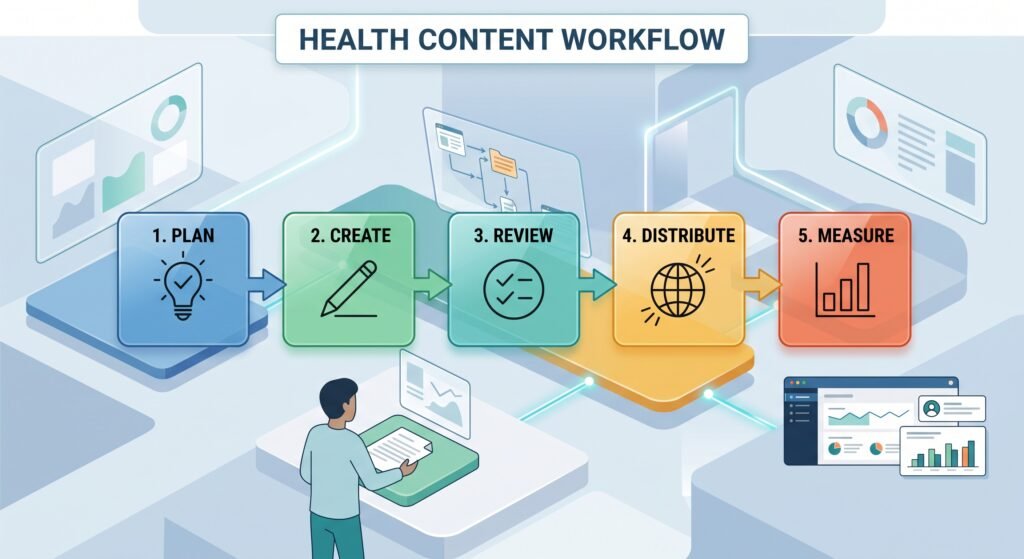
Health content has a different job from a general blog post. It needs to answer readers’ questions clearly, handle sensitive topics responsibly and reach people who are looking for practical guidance. For publishers and digital teams, that makes health publishing both an editorial challenge and a technology workflow problem. The right tools can help a team plan, produce and distribute useful articles without letting speed or search visibility take priority over reader trust.
Start with the reader’s need
Before choosing keywords or assigning a writer, define what a reader should be able to understand or do after reading. Someone searching for information about sleep, nutrition or a medical condition may be looking for basic education, help preparing questions for a clinician, or a comparison of available approaches. These are different needs, and they call for different formats and levels of detail.
Search data can help identify common questions, but it cannot establish whether a claim is sound or whether an article is appropriate for a particular audience. Use keyword research as a way to understand language and demand, then have an editor assess the topic’s scope and the expertise required. A useful brief should set out the intended reader, the article’s purpose, sources to consult and any claims that need specialist review.
Build quality checks into the workflow
Publishing software makes it easy to move a draft from a document into a content management system. That convenience is valuable, but a smooth workflow should include more than formatting and scheduling. For health topics, teams benefit from distinct steps for research, writing, review, editing and final publication. Assigning clear responsibility at each stage reduces the chance that a citation is lost or an important qualification is removed during revisions.
A practical checklist might cover:
- Whether the article answers the question stated in its headline and introduction.
- Whether health-related claims are supported by reliable, current sources.
- Whether the wording distinguishes established guidance from emerging evidence or personal experience.
- Whether the article avoids promising outcomes or implying that one approach suits everyone.
- Whether the page identifies its author and explains relevant review practices.
These checks should be proportionate to the subject. A general wellness feature may not need the same review process as content about diagnosis or treatment, but both should be edited for accuracy and clarity. Automated tools can flag broken links, spelling problems, duplicated passages or missing metadata. They should support human judgment, not replace it.
Use technology to make production consistent
When several contributors work on a site, a shared content system can prevent small production differences from becoming reader-facing problems. Templates can prompt writers to include a clear summary, descriptive subheadings, source notes and an appropriate next step. A project board can show who is responsible for research, editing and review, while version history helps teams see what changed and why.
Accessibility belongs in the same process. Use descriptive headings in a logical order, write meaningful link text, provide alternative text for informative images and check that text remains readable on mobile screens. Health readers may be tired, anxious or using a phone between other tasks; a page that loads quickly and is easy to scan is more useful than one crowded with pop-ups and competing calls to action.
Teams that lack an in-house developer or designer can bring in specific skills for a defined task. A freelance marketplace such as Osdire offers services across areas including programming, design, writing and marketing. Clear requirements, a realistic deadline and agreed review milestones make it easier to assess whether a contractor’s work fits the project. For any health-related assignment, the publisher still needs to decide who is responsible for factual review and final approval.
Think carefully about distribution
Once an article is ready, distribution should put it in front of readers who are likely to find it relevant. That may include a publisher’s newsletter, social channels, internal links from related pages or contributions to other websites. For guest posting, the subject and audience of the publisher matter more than a large list of placements. A useful contribution should fit the host site, offer information its readers can use and make the author’s expertise clear.
Researching suitable publishers can take time, especially when a campaign spans healthcare, fitness, nutrition, mental health and wellness. A directory such as iCopify’s health guest posting page lists health-related websites and blogs that businesses and agencies can review when planning outreach. Treat a listing as a starting point: check each site’s current content, audience, editorial standards and contribution terms before pitching. A relevant placement is more valuable than an unrelated one chosen solely for a backlink.
Measure usefulness, not just publication
Analytics can reveal whether readers reach an article, how they arrive and which pages they visit next. Those signals are useful, but they do not prove that health information was understood or acted upon. Pair traffic data with editorial checks: are readers finding answers to the questions the article set out to address, and are they navigating to appropriate supporting information?
A dependable health publishing workflow brings together careful research, accountable review, accessible design and relevant distribution. Technology helps teams coordinate those parts and spot preventable mistakes. It works best when the process remains guided by the reader’s needs and when visibility is treated as a way to deliver sound information, not as a substitute for it.