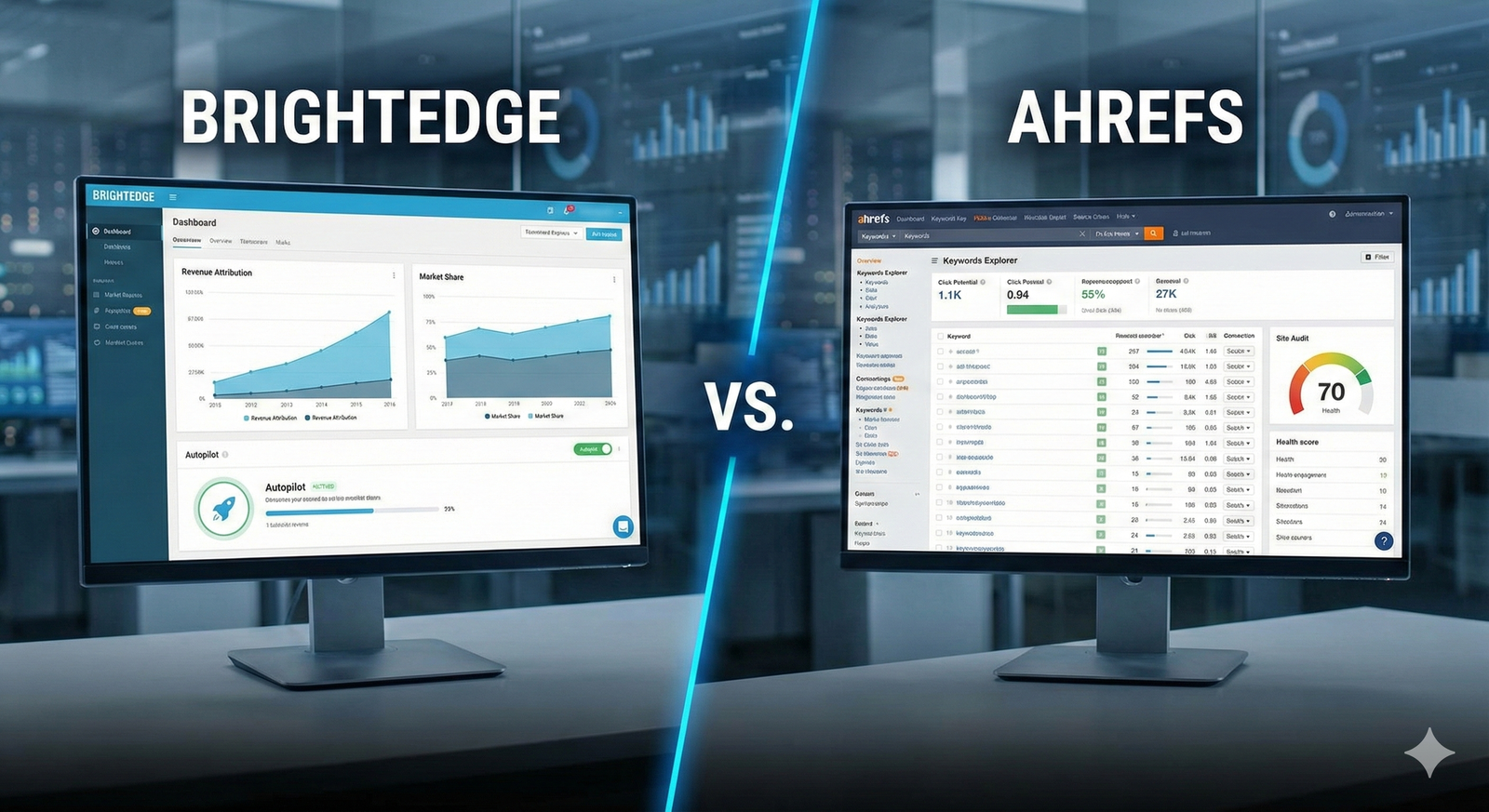
In the high-stakes world of Search Engine Optimization (SEO), choosing the right software stack is akin to choosing a business partner. It dictates your workflow, the accuracy of your data, and ultimately, your revenue. The debate often lands on two industry titans: BrightEdge vs. Ahrefs. While both platforms aim to improve your search visibility, they cater to vastly different ecosystems. Ahrefs is the darling of digital agencies and technical SEOs, renowned for its raw data power. BrightEdge, conversely, is the heavyweight champion of the enterprise world, built for boardrooms and revenue attribution.
This comprehensive guide dissects the nuances of both platforms. We won’t just list features; we will analyze how they function in real-world scenarios to help you decide which tool aligns with your business goals in 2026.
At a Glance: The Core Philosophy
Before diving into the granular details, it is essential to understand the DNA of each platform. They solve similar problems but approach them from opposite ends of the spectrum.
BrightEdge is an Enterprise SEO Platform. It is designed to integrate with other marketing channels, attribute SEO efforts directly to revenue, and provide high-level “Share of Voice” dashboards for executives. It focuses on scalability, workflow management, and AI-driven insights (like their Autopilot feature).
Ahrefs is an All-in-One SEO Toolset. It is built for execution. If you need to reverse-engineer a competitor’s backlink profile, find low-competition keywords in seconds, or audit a site’s technical health, Ahrefs is the industry standard. It prioritizes speed, data accuracy, and user experience over broad marketing integration.
Keyword Research: Data Cube vs. Keywords Explorer
Keyword research is the bedrock of any SEO strategy. Both tools offer massive databases, but the presentation and utility differ significantly.
Ahrefs Keywords Explorer
Ahrefs is famous for its clickstream data. It doesn’t just tell you the search volume; it tells you the Click Potential.
- Clicks vs. Volume: Ahrefs estimates how many searches actually result in a click, filtering out “zero-click” searches (like weather or currency conversion).
- Parent Topic: It automatically groups keywords, showing you the broader topic you should target to rank for hundreds of long-tail variations.
- Metric Precision: You get advanced metrics like Return Rate (how often people search again) and Clicks Per Search.
BrightEdge Data Cube
BrightEdge’s Data Cube is a powerhouse for enterprise-scale research.
- Share of Voice: Instead of just volume, it focuses on your market share for specific keyword clusters compared to competitors.
- Intent Signal: It categorizes keywords by user intent (Awareness, Consideration, Conversion), which is crucial for mapping content to the buyer’s journey.
- Opportunity Forecasting: It predicts the potential revenue lift if you improve rankings for specific terms, a feature Ahrefs lacks.
Verdict: Use Ahrefs for finding content ideas and validating search demand. Use BrightEdge for forecasting ROI and high-level strategy planning.
Backlink Analysis: The Quantity vs. Quality Debate
When it comes to link building, the size and freshness of the index matter.
Ahrefs: The Gold Standard
Ahrefs operates one of the most active web crawlers in the world (AhrefsBot), second only to Google in some sectors.
- Speed: New links are often discovered within minutes or hours.
- Index Size: It boasts a massive index of live backlinks, making it the preferred tool for link builders and PR teams.
- Link Intersect: A feature that allows you to see which sites link to your competitors but not you—a goldmine for outreach.
BrightEdge: The Strategic View
BrightEdge does not maintain its own backlink index to the same scale as Ahrefs. It often integrates third-party data (historically from partners like Moz or Majestic) combined with its own proprietary crawling.
- Focus: It prioritizes monitoring high-value links and their impact on page performance rather than raw discovery.
- Workflow: It excels at assigning link-building tasks to team members and tracking the status of outreach campaigns within the platform.
Verdict: Ahrefs is the undisputed winner for backlink analysis and active link building.
Technical SEO and Site Audits
A healthy website is a rankable website. Both tools offer crawlers to identify technical issues like broken links, slow pages, and missing tags.
- Ahrefs Site Audit: This is a visual, user-friendly tool. It provides a “Health Score” and breaks down issues by severity. It is particularly good at visualizing internal linking structures and identifying “orphan pages” (pages with no internal links).
- BrightEdge ContentIQ: This is an enterprise-grade auditor. It is highly customizable, allowing you to set specific crawl rules for different sections of a massive site (e.g., crawling only the /blog/ subdirectory). It integrates with Adobe Experience Manager and other CMSs to help fix issues faster.
Reporting and Dashboards: Who Are You Reporting To?
This is the biggest differentiator. Are you reporting to an SEO manager or a CMO?
Ahrefs
Reporting in Ahrefs is functional but basic. You can schedule PDF reports or use their Google Looker Studio connector (extra cost). The data is granular and technical—perfect for an SEO specialist who wants to see the movement of specific keywords or the acquisition of new referring domains.
BrightEdge
StoryBuilder is BrightEdge’s killer feature. It allows you to build stunning, executive-ready dashboards that mix SEO data with business metrics.
- Revenue Attribution: You can integrate analytics to show exactly how much revenue organic search generated this quarter.
- Executive Dashboards: Create simplified views for C-suite executives that focus on market share and growth, stripping away the technical jargon.
Pricing Models: Transparency vs. Customization
The cost structure of these two platforms reflects their target demographics.
Ahrefs Pricing
Ahrefs operates on a SaaS subscription model.
- Tiers: Plans range from Lite (~$99/mo) to Enterprise (~$999/mo).
- Credit System: In recent years, Ahrefs introduced a credit-based system where users are charged for data usage beyond their plan limits. This offers transparency but can get expensive for heavy power users.
- No Contracts: You can generally pay monthly or annually.
BrightEdge Pricing
BrightEdge uses a custom enterprise pricing model.
- Cost: Pricing is not public, but contracts typically start in the thousands per month (often $3,000 – $10,000+ depending on tracked keywords and domains).
- Contracts: Annual contracts are the norm.
- Add-ons: Features like HyperLocal or unlimited Data Cube access may cost extra.
Comparison Table: Feature by Feature
| Feature | Ahrefs | BrightEdge |
| Target Audience | SEO Pros, Agencies, SMBs | Enterprise, Fortune 500 |
| Backlink Data | Industry Leading (Fast & Huge) | Good (Aggregated/Strategic) |
| Keyword Research | Clickstream Data & Metrics | Intent-Based & Forecasting |
| Technical Audit | Visual & Easy to Use | Customizable & Scalable |
| Ease of Use | High (Intuitive UI) | Moderate (Steep Learning Curve) |
| Support | Chat & Email | Dedicated Customer Success Manager |
| Pricing | $99 – $999/mo (Transparent) | Custom ($3k+/mo est.) |
Support and Onboarding
Because BrightEdge is an enterprise solution, it comes with a “white glove” service. You are typically assigned a Customer Success Manager (CSM) who trains your team, helps set up dashboards, and ensures you are getting value. This is critical for large teams with varying levels of SEO knowledge.
Ahrefs, by contrast, relies on a self-serve model. They have an extensive “Academy” with high-quality video courses and a responsive support chat, but you won’t have a dedicated rep managing your account unless you are on their highest enterprise tier.
AI and Automation
Both platforms have integrated AI, but for different purposes.
- BrightEdge Autopilot: This feature can automatically optimize mobile pages, fix technical errors, and even generate image alt text. It acts as an extension of your development team.
- Ahrefs AI: Ahrefs uses AI primarily to assist in keyword clustering and content outlining. They are cautious about “black box” automation, preferring to give SEOs data to make their own decisions.
FAQs
Is BrightEdge worth the high cost compared to Ahrefs?
If you are a large organization that needs to prove the ROI of SEO to a board of directors, manage thousands of pages, and require dedicated support, yes. For smaller teams or agencies focused purely on ranking execution, Ahrefs offers better value.
Can I use both tools together?
Absolutely. Many enterprise teams use BrightEdge for reporting, forecasting, and on-page optimization, while their technical SEOs use Ahrefs for day-to-day link building and competitor research.
Which tool has better data accuracy?
Ahrefs is generally considered to have the most accurate backlink data and clickstream-based search volume. BrightEdge excels in rank tracking accuracy across thousands of local search engines and device types.
Does Ahrefs offer an API?
Yes, Ahrefs offers an API for enterprise plans, allowing you to pull their data into your own warehouses. BrightEdge also offers robust API integration, specifically for connecting with BI tools like Tableau or Domo.
Is BrightEdge hard to learn?
BrightEdge has a steeper learning curve than Ahrefs due to its complexity and depth of features. However, the dedicated account manager helps mitigate this challenge.
Which is better for Local SEO?
BrightEdge has superior Local SEO capabilities (HyperLocal), allowing you to track rankings in specific cities or zip codes at scale. Ahrefs provides local data but is less granular for multi-location franchises.
Does Ahrefs have a free trial?
Ahrefs currently offers “Ahrefs Webmaster Tools” for free (limited access for your own sites) but typically does not offer a free trial for its full premium suite.
Conclusion
The choice between BrightEdge vs. Ahrefs is not about which tool is “better” in a vacuum; it is about which tool fits your organizational maturity.
Choose Ahrefs if you are a doer. If your day involves hunting for backlink opportunities, analyzing competitor content gaps, and fixing broken redirects, Ahrefs is the sharpest knife in the drawer. It is fast, accurate, and beloved by the SEO community.
Choose BrightEdge if you are a strategist. If your role involves managing a global website with 50,000+ pages, coordinating a team of ten writers, and presenting quarterly growth charts to the VP of Marketing, BrightEdge provides the infrastructure you need. It transforms SEO from a technical checklist into a business intelligence asset.