
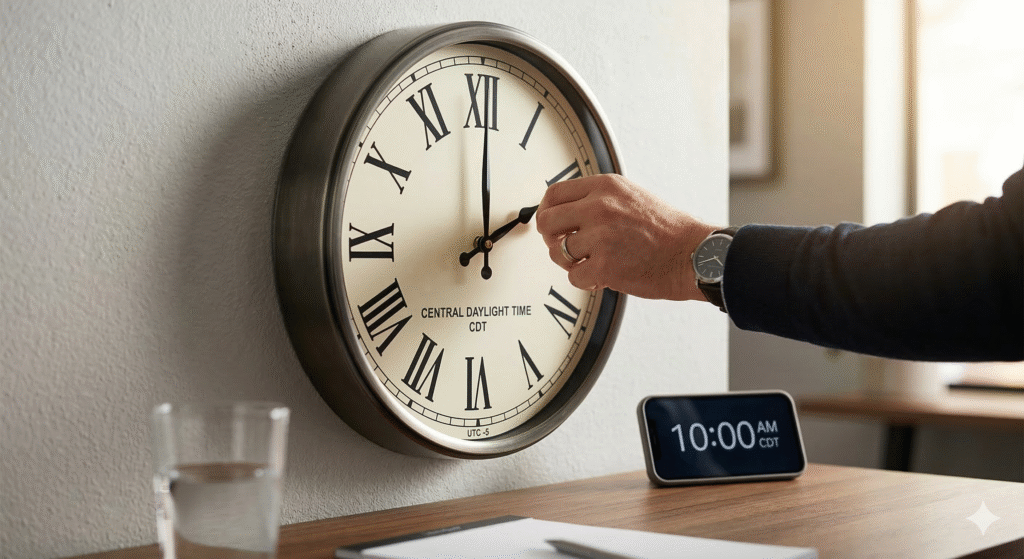
In our interconnected digital world, time is more than just a number on a clock; it is the heartbeat of global coordination. Whether you are a developer syncing server logs, a project manager scheduling a cross-border meeting, or a gamer waiting for a live event, understanding CDT Time is essential. Central Daylight Time (CDT) represents a crucial offset used by millions across North America to maximize evening light during the warmer months.
Precision in time zones prevents missed deadlines, scheduling conflicts, and technical glitches in distributed systems. Yet, for many, the shift between “Standard” and “Daylight” remains a source of confusion. This article serves as your comprehensive resource, providing a deep dive into the technicalities, geographical reach, and practical applications of CDT Time. We will break down its relationship with Coordinated Universal Time (UTC), clarify the annual transition dates for 2026, and offer actionable insights for managing time in a tech-driven landscape. By the end of this guide, you will have a master-level understanding of this specific time offset and how it impacts both daily life and digital infrastructure.
What Exactly is CDT Time?
CDT Time stands for Central Daylight Time. It is the practice of advancing clocks by one hour during the summer months in the Central Time Zone of North America. This shift is designed to provide an extra hour of daylight in the evening, rather than the early morning.
- Abbreviation: CDT
- UTC Offset: UTC -5 (5 hours behind Coordinated Universal Time)
- Status: Daylight Saving Time (DST) version of Central Time
- Primary Region: Parts of USA, Canada, and Mexico
The Relationship Between CDT and UTC
To understand CDT Time on a technical level, one must look at its offset from Coordinated Universal Time (UTC). UTC is the primary time standard by which the world regulates clocks and time. Unlike UTC, which never changes, CDT is a seasonal adjustment.
- The Calculation: $CDT = UTC – 5$
- Military Designation: Often referred to as “Romeo Time Zone” in military contexts.
- Standard Counterpart: During winter, this region reverts to CST ($UTC – 6$).
Transition Dates for 2026
For residents and businesses observing CDT Time in 2026, the calendar follows a strict federally mandated schedule in the United States. Knowing these dates is vital for updating automated systems and manual clocks.
- Start Date: Sunday, March 8, 2026 (Clocks moved forward at 2:00 AM)
- End Date: Sunday, November 1, 2026 (Clocks move back at 2:00 AM)
- Total Duration: 238 days of daylight observance.
Geography: Who Uses CDT Time?
CDT Time is not just a “U.S. thing.” It spans across the heart of North America, covering diverse climates and cultures. From the Great Lakes of Canada down to the border regions of Mexico, this offset is a shared reality for millions.
- United States: Covers 20 states, either fully or partially (e.g., Illinois, Texas, Minnesota).
- Canada: Observed in Manitoba, parts of Ontario, and the Kivalliq Region of Nunavut.
- Mexico: Border municipalities often align with U.S. time for trade convenience.
Comparing CDT to CST
The most common mistake is using “CST” and “CDT Time” interchangeably. While both belong to the Central Time Zone, they represent different offsets depending on the time of year.
| Feature | Central Daylight Time (CDT) | Central Standard Time (CST) |
| UTC Offset | UTC -5 | UTC -6 |
| Season | Spring / Summer / Fall | Winter |
| 2026 Active | March 8 – Nov 1 | Nov 1 – March 8 |
| Daylight Status | Daylight Saving Active | Standard Time |
Technical Applications in Software Development
In the tech niche, CDT Time is a critical variable in database management and API integration. Developers must ensure that their applications handle the transition between CST and CDT without losing data integrity or causing scheduled tasks to fail.
- ISO 8601 Formatting: Represented as
YYYY-MM-DDThh:mm:ss-05:00. - Unix Timestamps: These remain UTC-based, but UI layers must convert them to CDT for local users.
- Crontab Risks: Be careful with tasks scheduled at 2:00 AM during transition nights.
CDT in Global Business Scheduling
Coordinating a meeting between London (BST) and Chicago (CDT Time) requires precise calculation. Because different countries change their clocks on different weekends, the “time gap” can shift unexpectedly for a week or two each year.
- The 6-Hour Gap: London is typically 6 hours ahead of Chicago during the summer.
- The 5-Hour Gap: This occurs during the brief window when the UK has switched to BST but the US has not yet moved to CDT.
- Scheduling Tools: Using World Time Buddy or Google Calendar helps automate these shifts.
Why Central Daylight Time Matters for Gamers
For the gaming community, CDT Time is often the “anchor” for North American server resets and live stream events. Many major developers, such as those behind Wuthering Waves or Destiny 2, use Central Time as a middle-ground reference for their player base.
- Live Stream Timings: Often announced in CDT to cater to both East and West Coast players.
- Server Maintenance: Usually scheduled during the late night/early morning CDT hours to minimize impact.
- Patch Releases: Often occur at 10:00 AM or 12:00 PM CDT.
States That Observe Central Time Partially
Not every state in the Central Time Zone is fully committed to CDT Time. Some states are split between two zones, which can create confusion for travelers and local logistics.
- Tennessee: Split between Eastern and Central; cities like Nashville use CDT.
- Florida: The Panhandle (West of the Apalachicola River) follows CDT.
- Indiana: Mostly Eastern, but several counties in the Northwest and Southwest observe CDT.
- Kentucky: Roughly the western half of the state stays on Central Time.
Major Cities Operating on CDT
If you are doing business in the following metropolitan areas during the summer, you are working on CDT Time. These hubs drive a significant portion of the North American economy.
- Chicago, IL: The largest city in the zone and a global financial hub.
- Dallas/Fort Worth, TX: A massive tech and logistics center.
- Houston, TX: The center for energy and space exploration (NASA).
- Winnipeg, MB: A key Canadian transportation link.
Impact on Human Health and Productivity
The shift to CDT Time in March popularly known as “Springing Forward” has measurable effects on the human body. Losing that one hour of sleep can disrupt circadian rhythms for several days.
- Circadian Rhythm: The sudden change affects melatonin production.
- Workplace Productivity: Some studies show a slight dip in focus the Monday following the change.
- Morning Light: Shifting light to the evening can make waking up in the morning harder in early spring.
Daylight Saving Time Controversies
The continued use of CDT Time is a hot topic in many legislatures. Some argue for “Permanent Daylight Saving Time,” which would mean staying on CDT year-round and never “falling back” to CST.
- Energy Savings: Original arguments for DST centered on fuel conservation, though modern benefits are debated.
- Economic Boost: Retailers often prefer CDT because people stay out longer when it is light outside.
- Safety Concerns: Critics point to darker mornings being dangerous for children walking to school.
Case Study: Logistics in a Split State
Consider a delivery truck traveling from Indianapolis (Eastern Time) to Gary, Indiana (CDT Time). Despite being in the same state, the driver “gains” an hour upon crossing the county line.
- The Challenge: Aligning delivery windows and driver logs.
- The Solution: Most logistics companies use UTC for internal tracking and local offsets for driver instructions.
- Result: Reduced “late” deliveries caused by simple math errors during zone transitions.
Setting Your Devices to CDT Automatically
In the modern era, you rarely need to change your clock manually. However, understanding how your device handles CDT Time can help you troubleshoot if your phone fails to update.
- Network Provided Time: Most smartphones sync with cell towers to update instantly.
- BIOS/CMOS: PCs store a hardware clock; your Operating System (Windows/macOS) applies the CDT offset.
- Manual Override: If traveling, ensure “Set time zone automatically” is enabled in your settings.
The Future of Time Zones
As we move toward 2027 and beyond, the debate over CDT Time vs. permanent time standards continues. Several U.S. states have passed bills to stay on Daylight Time permanently, pending federal approval.
- Sunshine Protection Act: A proposed law that would make CDT the new “standard” year-round.
- Global Trends: Some countries (like Mexico in recent years) have moved to abolish DST entirely in most regions.
- Digital Preparedness: Tech infrastructure is already capable of handling these shifts, provided IANA databases are updated.
FAQs
Is CDT the same as Central Time?
Central Time (CT) is the general name for the time zone. CDT Time is the specific version used during the summer when Daylight Saving is active. In the winter, the zone is called CST.
What is the difference between CDT and EDT?
EDT (Eastern Daylight Time) is one hour ahead of CDT Time. If it is 12:00 PM CDT in Chicago, it is 1:00 PM EDT in New York City.
Which countries use CDT besides the United States?
Canada uses CDT Time in provinces like Manitoba and parts of Ontario. Parts of Mexico near the U.S. border also observe it to stay aligned with American business hours.
How do I convert UTC to CDT?
To get CDT Time, subtract 5 hours from the current UTC time. For example, if it is 15:00 UTC, it is 10:00 AM CDT.
Why does Arizona not use CDT?
Arizona stays on Mountain Standard Time (MST) year-round and does not observe daylight saving. This means during the summer, they have the same time as the West Coast (PDT), not the Central region.
Does the UK ever use CDT?
No, the UK uses Greenwich Mean Time (GMT) in the winter and British Summer Time (BST) in the summer. They are usually 6 hours ahead of the CDT Time zone.
What happens if I miss the transition to CDT?
If you forget to move your clock forward in March, you will be “late” for everything by one hour. Most digital devices update automatically, so this is mostly an issue for analog wall clocks.
Conclusion
Understanding CDT Time is a fundamental skill for navigating the complexities of modern life. It is more than just a seasonal shift; it is a calculated adjustment that affects international trade, digital synchronization, and personal well-being. By staying 5 hours behind UTC, the Central Daylight Time offset ensures that millions of people can enjoy extended daylight, fostering social activity and economic growth during the most vibrant months of the year.
As we look toward the 2026 transitions, the importance of accuracy cannot be overstated. For professionals in the tech and information sectors, mastering this time zone means ensuring that systems remain robust and schedules remain tight. Whether you are adjusting a server’s cron job or simply planning a family call across the country, knowing when to “spring forward” into CDT keeps you in sync with the world around you.
The ongoing debates regarding permanent daylight time suggest that our relationship with the clock is still evolving. Until a final decision is made at a federal level, the cycle of CST and CDT remains our standard. Stay informed, keep your devices updated, and make the most of those long summer evenings.